If you’ve read Centralized Exchanges, then you know what limit and market orders are. Order Flow is simply the flow of these orders over time. Order Flow Analysis is the process of finding pattners in order flow data. For example, large limit orders may appear in the order book and seem to protect a certain price level, but as soon as the price approaches them, they get pulled away. There are many ways to visualize order flow. You can read about some of them here. We’ve developed our way to visualize it - Unified Order Flow. Let’s walk you through it.

Limit Orders

Order Book is a list of bids and asks. Each bid and ask is a pair of a target price level and a quantity of an asset. Some exchanges use the terms “size” and “amount” as alternatives to “quantity”.

7dae9f09 C8ef 449b Af26 9d478cba5adc 2
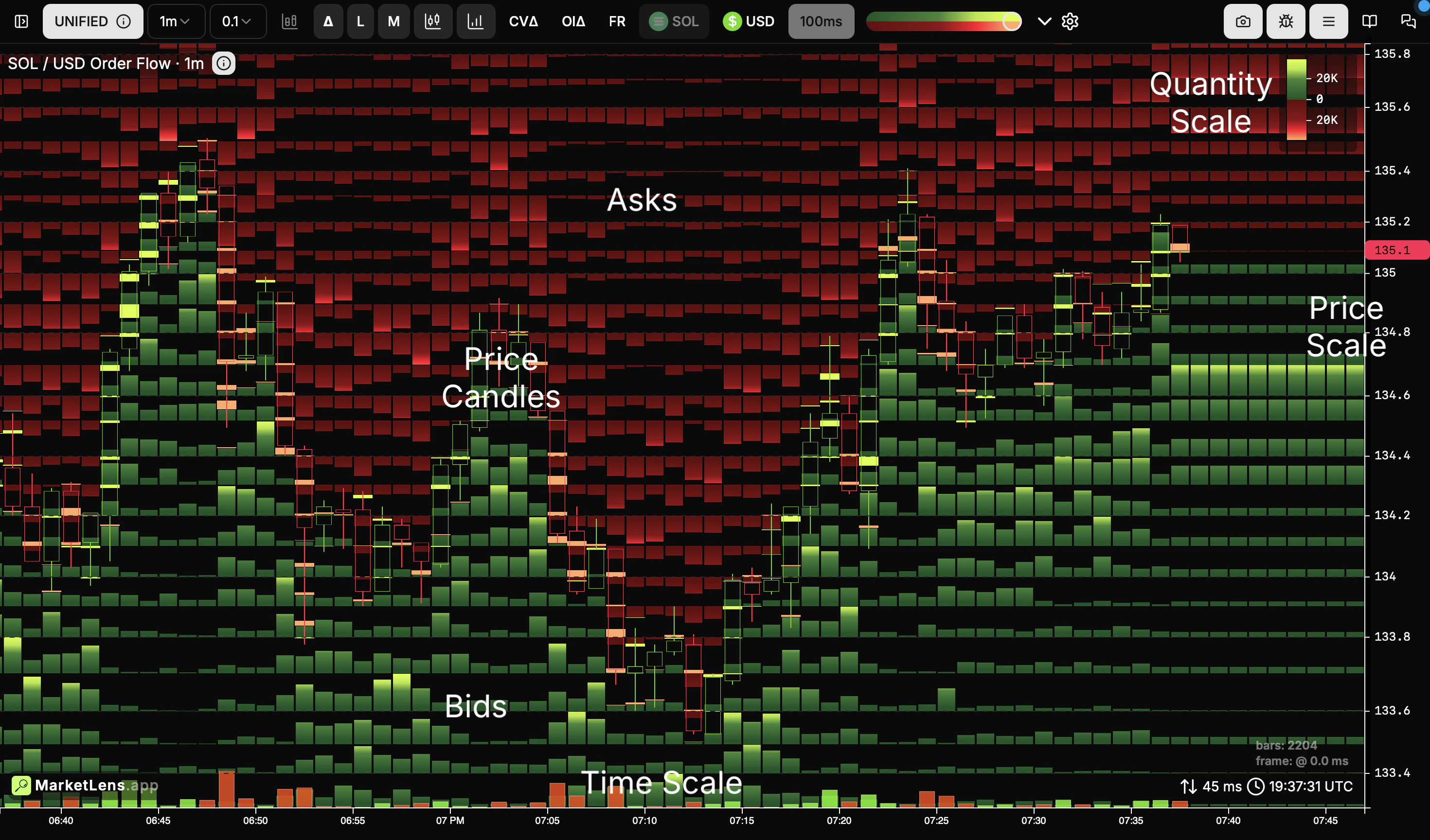
Let’s explore what we see in an example of Binance SOL/USDT perpetual futures, which has a minimum price step of 0.01 and we have price aggregation - 0.1
1d18136e B418 4a59 9289 E13c54fcb1e9 2
The whole space is broken into price ranges, for example, a price range from 134.2 (visible on the right scale) to 134.3 (marker is not shown for compactness). The space inside these ranges shows bar charts. Bars extending upward from the bottom of the range are bids for the lower bound (134.2 in the example) and bars extending downward from the top of the range are asks for the upper bound (134.3). Every bar is the last bid or ask quantity within the selected timeframe (1m in the example).
C559403f Dd41 4216 8ccd F516ccd34412
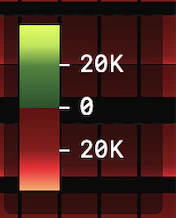
The heights of the bars are uniform - N pixels represent the same quantity according to the quantity scale in any place on the screen. Color intensities of the bars are here to visuallly distinguish different ranges and bring attention to bigger quantities, where color intensities match those on the quanaity scale legend. The Price Scale, on the other hand, is not uniform - pixel heights between levels may vary depending on vertical space needed to fit bids and asks inside ranges. This may seem unusual; however, from our point of view, it reflects the fact that price levels are not equally importantand when large quantities separate them it’s logical for them to be distant. Additionally, this chart shows classic Price Candles, according to the non-uniform price scale.

Market Orders

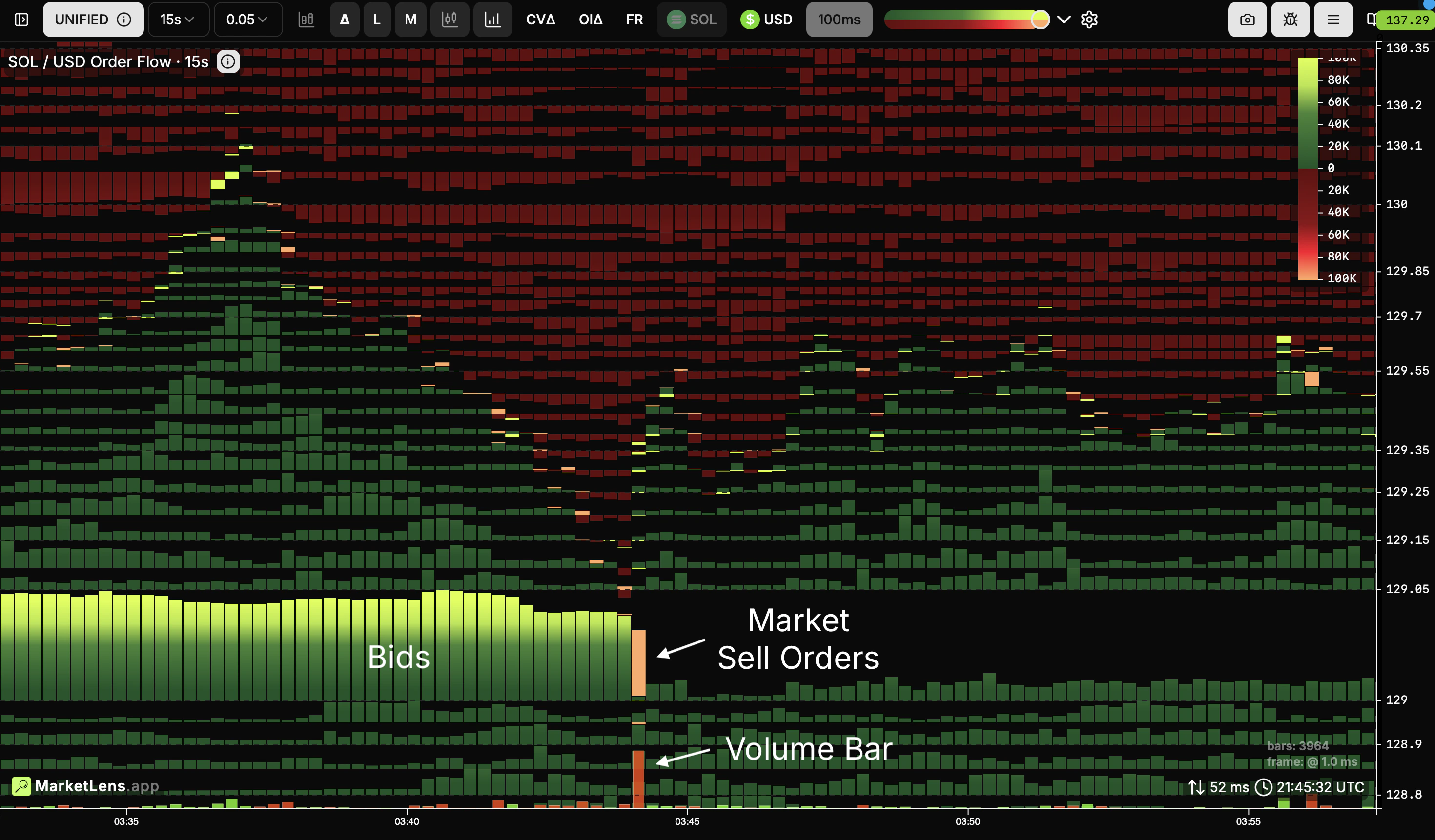
The chosen presentation gives an advantage by easily showing market orders, which is not possible on heatmaps.
9a3cde7c Ab1f 4cde A3c8 7d739d7ce898
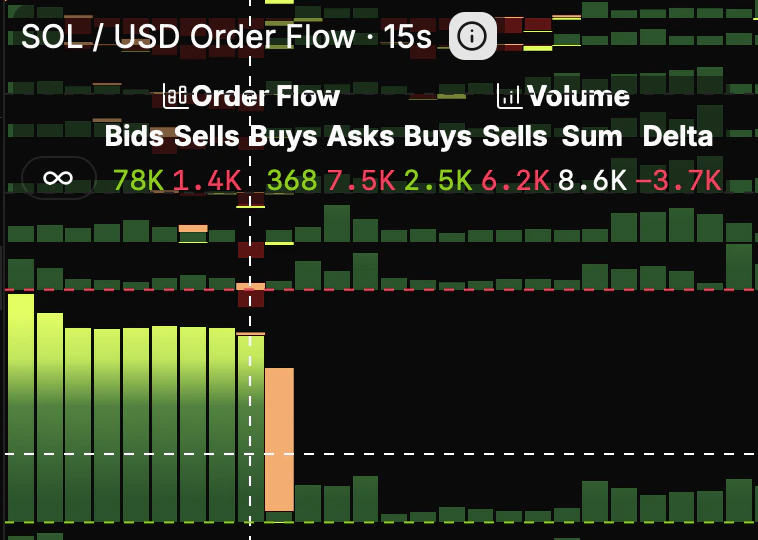
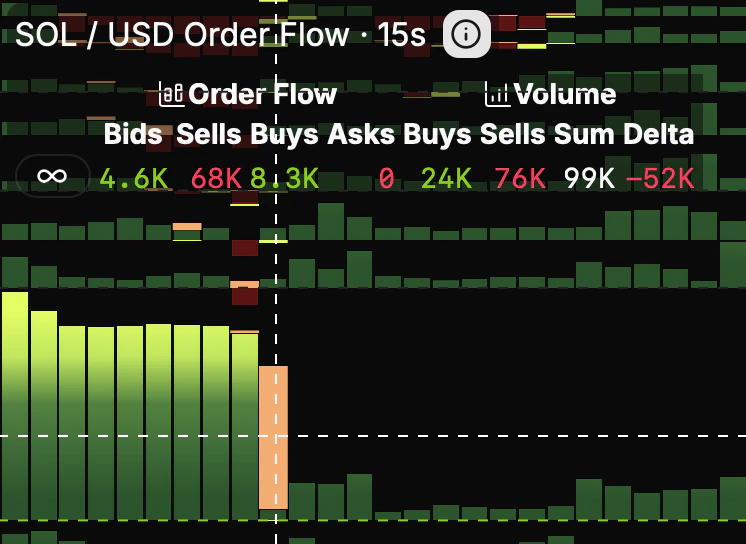
It’s the same SOL/USDT chart with 15s timeframe selected. Here, you can see how market orders cut through limit orders.
Add0b511 6f51 4283 9880 5cec0619bb67
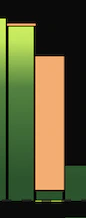
This bar shows that during that 15 seconds, market orders took almost all limit orders at the price of 129.0.
F6caf8bd 703f 4111 8197 6ea3e4d65874
Cedf3530 9ab2 452e 83c7 7c20ebf76696
A quick glance at quantity legend let us see that the bid was ~78K SOL and ~68K quantities were taken by market orders. Market orders are colored red for market sells and green for market buys; they have solid color and no gradient compared to limited orders to bring attention to them. Additionally, please take a look at volume bars; they have approximately the same heights as the corresponding market orders, as they belong to the same uniform space of order quantities.

Multiple Markets

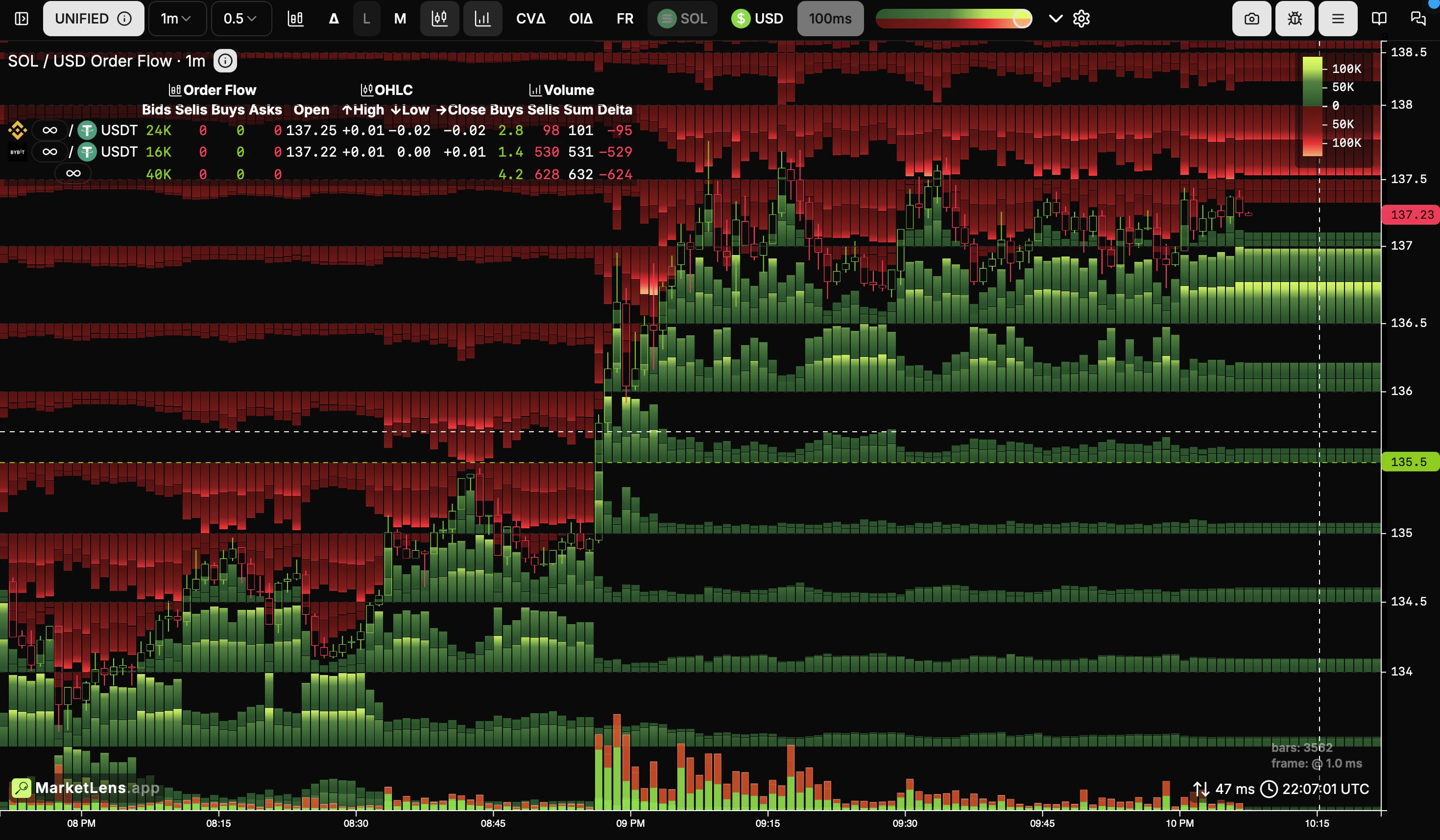
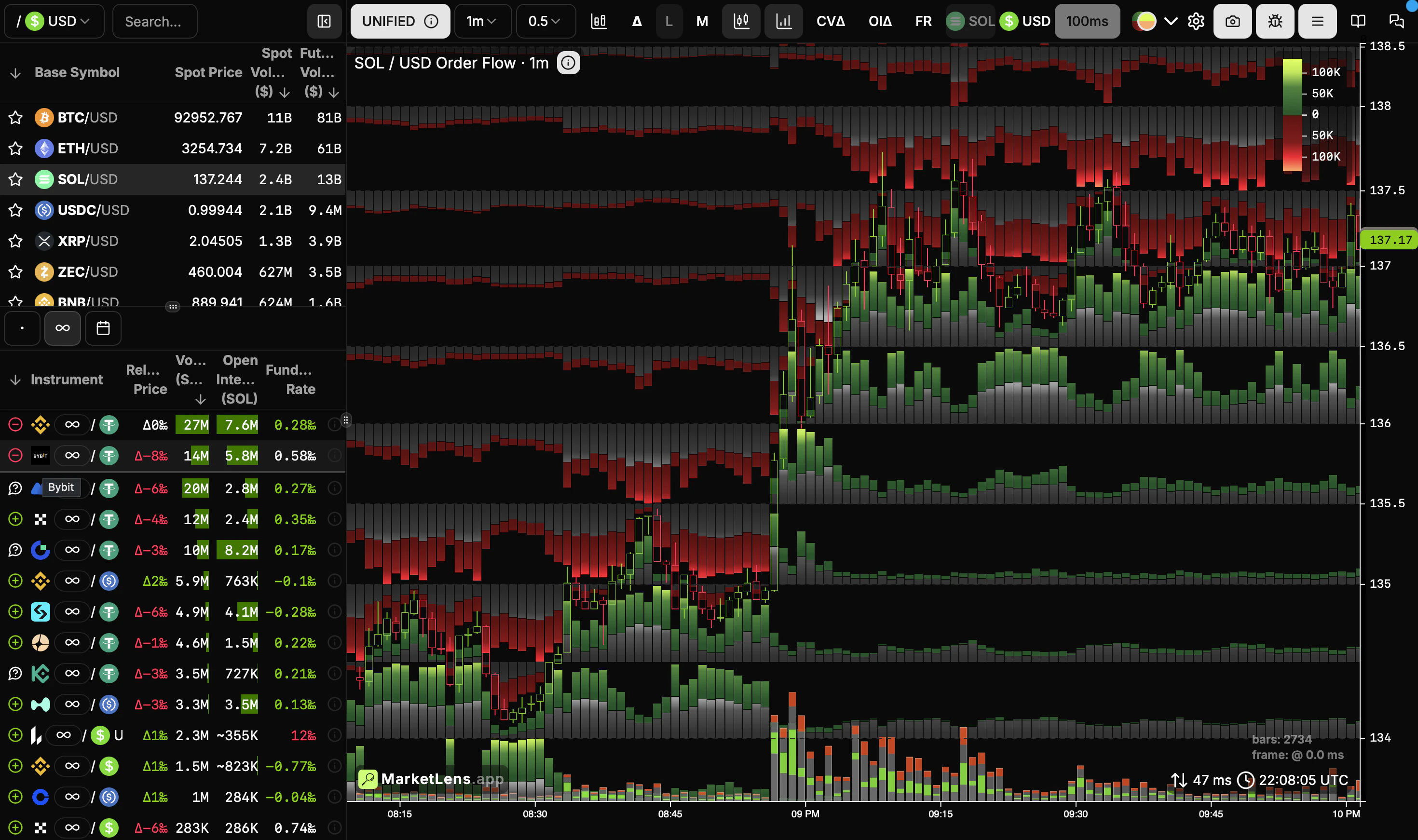
Data from multiple markets can be easily combined in a uniform quantity space. Below, you can see Binance and Bybit BTC/USDT perpetual futures shown at the same time. Bids and asks are layered within ranges. Only limit orders are shown for simplicity.
74e0a948 8e2d 4b04 Ae02 0f08999f57e0
Any selected symbol can be highlighted separately.
432f98be 00db 4d80 8d2c Ba290eefc85a
Market orders are aggregated the same way.