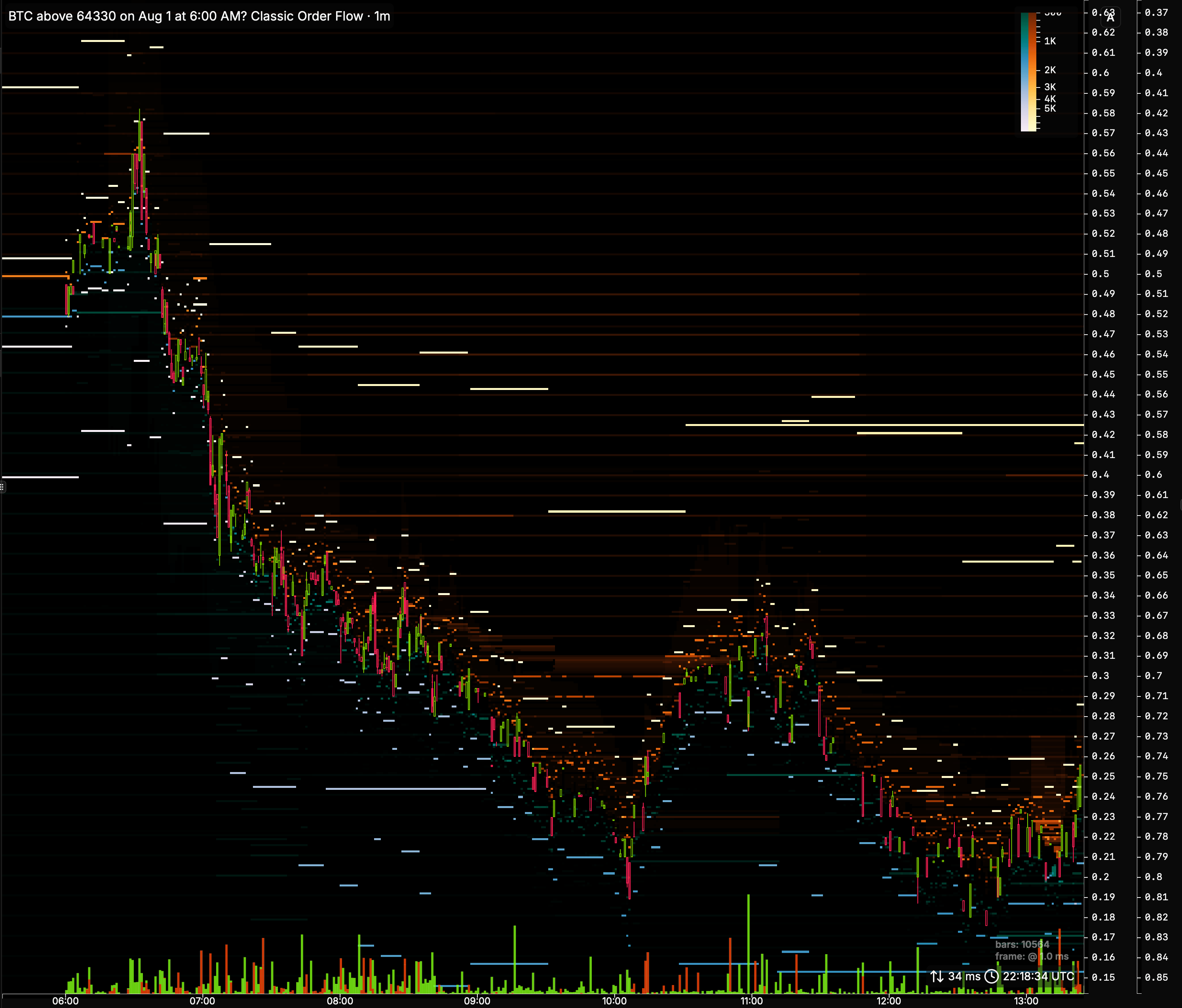
Prediction markets (including Hyperliquid HIP-4 outcome markets and venues like Polymarket) trade fully collateralized outcome tokens that settle inside a fixed range. The usual binary case is Yes / No. They use the same limit and market order types you already know from exchanges. The microstructure is different: two complementary books, prices only from 0 to 1, and matching that often links Yes and No.

Spot and futures vs outcomes

HIP-4 describes outcomes as contracts that settle within a fixed range, useful for prediction markets and other bounded instruments. Polymarket’s binary markets use the same economic idea: a complete Yes+No set is backed by one unit of collateral.

Prices from 0 to 1

Each share costs somewhere between nothing and one full unit of quote (often written like $0.00 to $1.00). That scale doubles as a simple probability: 0.25 ≈ 25% chance, 0.75 ≈ 75%. If the event resolves Yes, a Yes token is worth 1 and No is worth 0 (and the reverse if No wins). Before resolution, you can buy or sell either side on the book. Because Yes and No are complements for a binary market:
when the books are tight and arbitraged. A bid to buy Yes at p is economically the same idea as selling No at 1 − p (see matching below).

Dual order books

A binary market has two tokens and, from a reading perspective, two books:
  • Yes book — bids and asks on Yes
  • No book — bids and asks on No
You still place ordinary bids (buy) and asks (sell) on a chosen side. Depth, spread, and tape exist per side the way they do on spot.

Why two books?

  1. Two tradeable claims. Traders express “this happens” or “this does not” without shorting a single unbounded asset in the futures sense.
  2. Bounded risk. Buying Yes at 0.40 risks at most 0.40 of collateral per share if Yes loses; max win is 0.60 to 1.00. No open-ended mark-to-market like a leveraged perp.
  3. Shared economics. One unit of collateral can mint a complete set (1 Yes + 1 No). That ties the two books together.
On Polymarket, splitting $1 of collateral creates 1 Yes + 1 No; merging both sides returns $1. HIP-4 similarly supports split/merge of outcomes and treats the two sides as a dual system.

Merged liquidity (HIP-4)

Hyperliquid merges Yes and No books so they share liquidity. Explicitly:
  • Buy Yes at price p is equivalent to sell No at price 1 − p
  • Priority on the merged book is price–side–time: at the same merged price, resting sells are ranked ahead of dual buy interest
Most trading UX hides that duality; under the hood, a single aggressive order can interact with liquidity that was posted on the other side. Polymarket’s CLOB is the same complementary dual-token model. Infrastructure differs (e.g. offchain matching + onchain settlement on Polymarket vs HyperCore for HIP-4), but the book logic traders care about is the same: prices only from 0 to 1, Yes/No complements, complete sets worth 1.

Limit and market orders

Same verbs as on a CEX:
  • Limit — rest at your price (or better). Guarantees price, not fill.
  • Market — take liquidity now. Guarantees urgency, not price.
On Polymarket, “market” orders are typically implemented as aggressive limits that cross the book. HIP-4 outcome trading is API-similar to spot, with outcome-specific asset IDs and dual-book rules. You can:
  • Buy Yes (or No) with a limit or a marketable order
  • Sell tokens you already hold
  • Provide liquidity on one side while others trade the dual side

How matching works

1. Same-side CLOB matching

On a single side (e.g. Yes only), matching is the usual central limit order book:
  1. An incoming buy matches the lowest ask if the buy price ≥ ask price.
  2. An incoming sell matches the highest bid if the sell price ≤ bid price.
  3. Resting orders keep price–time priority (on HIP-4’s merged book, price–side–time at equal merged price).
Trades print when one side takes the other. Partial fills are normal.

2. Complements and complete sets

Because Yes and No sum to one unit of collateral, liquidity can form across sides. Classic complementary match (Polymarket-style price discovery):
  1. Trader A bids to buy Yes at 0.60
  2. Trader B bids to buy No at 0.40
  3. 0.60 + 0.40 = 1.00 → the system can mint a complete set: A receives Yes, B receives No, $1 collateral is locked
No one needed a resting ask on Yes if the dual buy completes the set. Equivalence view (HIP-4 merged book):
  • Buying Yes at p competes with selling No at 1 − p
  • Selling Yes at p competes with buying No at 1 − p
So when you read two books in MarketLens, you are not looking at two unrelated instruments. You are looking at one bounded market expressed twice, with matching that can cross the dual.

3. After the trade

  • Positions are balances of Yes and/or No tokens.
  • Before settlement, you can sell on the book, or merge a complete set back to collateral where the venue allows.
  • At settlement, winning side pays out per the settle rule; the losing side goes to zero.

Reading dual books in practice

  • Tight Yes and No books with midpoints summing near 1 → coherent market.
  • Wide spread on one side only → liquidity or inventory is skewed; the dual may still trade.
  • Large size on Yes bids near p is related to No offers near 1 − p when books are merged or arbitraged.
For how MarketLens shows HIP-4 markets in the product, see HIP-4.

References